
What is domestic biomass boiler installation?
Domestic biomass boiler installation means fitting a wood-fuelled boiler that heats your radiators and hot water. Most homes burn pellets or logs, and a few use chip. It tends to suit houses that are off the gas grid, where the alternative is oil, LPG or electric heating, and where there is somewhere dry to keep the fuel.
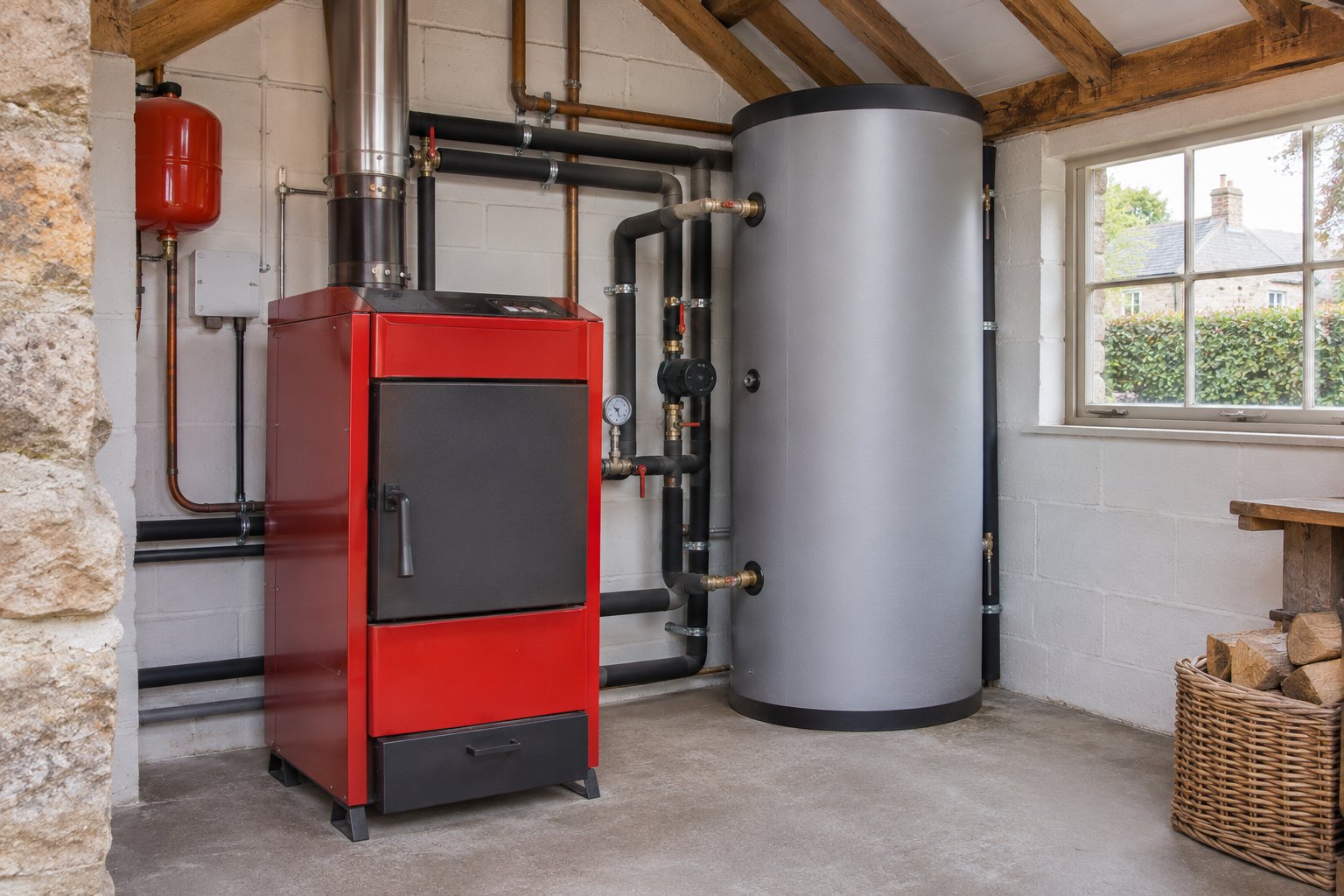
The job is bigger than swapping one boiler for another. A competent installer works out how much heat the house loses, picks an output to match, adds a buffer tank if the design calls for one, builds or fits a fuel store, runs a flue to the right height and commissions the system. The required output depends on the heat-loss calculation. An oversized boiler cycles on and off, wastes fuel and leaves more soot in the flue.
Signs you need domestic biomass boiler installation
- You heat with oil, LPG or storage heaters and the running costs keep climbing.
- The house is off the gas grid and you want to move away from a fossil fuel boiler.
- You have an outbuilding, garage or lean-to close enough to the house to hold a fuel store.
- Your current boiler is close to the end of its life and you are planning the next system from scratch.
- There is a chimney, or a wall where a new flue could rise, that a specialist could assess.
Domestic biomass boiler installation options explained
The fuel you choose shapes everything else, from the size of the store to how much of your week the boiler takes up.
Wood pellet boilers
Pellet boilers feed themselves from a hopper or store, so they feel closest to running oil. They need a dry space for the pellets, regular deliveries and a yearly service. Ask whether automatic feeding suits the space and fuel deliveries you can arrange.
Log gasification boilers
A log boiler costs less to buy but you load it by hand, often once or twice a day. It needs a large heat store (an accumulator tank) to burn cleanly, so allow room for a tall tank beside the boiler. It suits households with their own supply of seasoned wood.
Wood chip boilers
Chip is cheap per kilowatt hour where it is grown locally, but it needs a big store and a feed system built for it. It turns up mostly on farms and larger rural properties rather than ordinary houses.
Designing around the house
Ask where the buffer tank will stand and how it will get through the doorway. A buffer tank stores heat for later use, so its size belongs in the system design. Check whether the quote covers changes to the hot water cylinder and heating controls.
After commissioning, ask for a demonstration of heating schedules, ash removal and the normal shutdown procedure. Keep the fuel specification with the manual. The handover should also identify who to call if the controller shows a fault.
What to include when asking for a quote
Start with the house. Give the specialist its age, construction, floor area and loft and wall insulation, and say whether you already have radiators and a hot water cylinder. Recent fuel bills or an EPC help a lot. A quote that skips the heat-loss calculation is really a guess at boiler size.
Next, describe the plant space and the fuel. Say where the boiler could stand, with photographs and the door and ceiling heights, because buffer tanks are tall. Say where fuel would be kept, how close a delivery lorry can get and which wall or chimney could carry the flue.
A written quote names the boiler make and output, lists the tank and cylinder work, states exactly what the store and the flue involve, and says who deals with Building Regulations notification and any grant paperwork. Ask whether removing the old boiler or oil tank is included, and what happens if the survey finds a cracked chimney.
How much does domestic biomass boiler installation cost?
| Type of job | Budget range |
|---|---|
| Smaller home, pellet or log boiler, existing flue reused | £11,000–£15,000 |
| Typical 20–30 kW system with a new flue and buffer tank | £15,000–£20,000 |
| Larger home or complex job with a new store or long pipe runs | £20,000–£24,000 |
Our indicative UK range for domestic biomass boiler installation is £11,000–£24,000, before any grant. The fuel store, the flue and the distance between the boiler room and the house move the price more than the boiler itself. Treat the range as a budgeting guide rather than a tariff, and ask each business to price the store and flue as separate lines.
Our budgeting range was checked against published installer cost examples. Published prices have different inclusions; confirm VAT, travel and exclusions in your own quote.
The domestic biomass boiler installation process: what to expect
- A specialist visits, measures the house and the proposed plant room and carries out a heat-loss calculation.
- You receive a design and a written quote naming the boiler, tank, store and flue.
- The installer prepares the site, which can include a new flue, a plinth and the fuel store.
- The boiler, buffer tank, pipework and electrics go in, and the old heating is disconnected on changeover day.
- The system is commissioned, the flue is tested and you are shown how to load or refill fuel and empty the ash.
- You receive the commissioning record, Building Regulations paperwork and warranty details.
Planning permission and building regulations
In England and Wales a new solid fuel boiler counts as notifiable building work. An installer registered with a competent person scheme can self-certify it, or you can use local building control instead. HETAS guidance on Building Regulations explains the difference, and the gov.uk guidance on Building Regulations approval covers the building control route. Scotland and Northern Ireland have their own approval systems.
Ask the local planning team about the proposed flue, particularly for a listed building or a conservation area. If you live in a smoke control area, read the gov.uk smoke control area rules because you may need an exempt appliance. Eligible off-grid homes in England and Wales may also qualify for a grant; see the gov.uk Boiler Upgrade Scheme page for current terms.
How to choose a domestic biomass boiler installation specialist
Put these questions to each specialist while they are standing in your plant room.
- Are you registered with HETAS or another competent person scheme, and will you notify Building Regulations?
- Will you carry out a proper heat-loss calculation, and can I see it?
- Which boiler do you recommend and why that make and output?
- Does your price include the flue, the fuel store and removal of the old boiler?
- Who handles any grant application, and how long is the warranty?
Frequently asked questions
How long does a domestic biomass boiler installation take?
Allow four to ten days on site for a typical home. It runs longer if a flue liner or fuel store has to be built first. Your old heating normally stays on until the changeover day.
Is a biomass boiler suitable for my house?
It suits houses with room for a boiler, tank and fuel store, a route for a flue and enough heat demand to justify the cost. Rural homes on oil are the usual case. Only a survey can tell you for certain, and small, well insulated properties often fit better with other heating.
Can I get a grant for a biomass boiler?
Some homes in England and Wales may qualify under the Boiler Upgrade Scheme, subject to its biomass eligibility conditions. Check the current rules for your property before relying on funding. Support elsewhere in the UK follows separate arrangements.
How much does a domestic biomass boiler installation cost?
Our guide is £11,000–£24,000 before any grant. The flue, the fuel store and the size of the house make the biggest difference to the final figure.
Related biomass work
For related work, compare the scope of wood pellet boiler replacement and fuel store and hopper installation before you book.
Request a price for your biomass boiler
Use the free biomass boiler enquiry form to describe the work. Up to four independent businesses may reply, depending on coverage and availability. Getbiomassboiler.co.uk introduces enquiries. It does not do the work or employ the engineers, and you agree the price and contract with the business you choose.
If a carbon monoxide alarm sounds, leave the building and get urgent advice. Do not wait for quote replies, and do not restart the boiler until a competent professional has checked it. Follow the HSE advice on suspected carbon monoxide exposure.